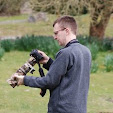
The weather has been pretty awful so far in 2026, forcing a multi-day closure of the Stoborough Causeway which is my main route south out of Wareham in late January/early February. In 'normal' flood conditions, it's still usually possible to cycle across on the raised pavement, but when I attempted to do so on 31st January I underestimated the depth of the water and ended up pushing myself along with my left foot on the the roadside fence as it was too deep to pedal through.
 |
Black Redstart, the Nothe, 16th February
|
 |
| Black Redstart, the Nothe, 16th February |
 |
| Black Redstart, the Nothe, 16th February |
Having made the crossing relatively unscathed I went on to dip a Brambling at Thrasher's Lane then pressed home my disadvantage by dipping a Red-necked Grebe (for the second time) at Studland. This gave me such a hump that the very next day I headed for Portland Harbour to look for another of the same species, where they are usually a bit easier to locate in the area between Sandsfoot Castle and the harbour wall. It took a bit of finding, but with some help from a telescope and the local grapevine I eventually relocated it close to a dozen or so Great Crested Grebe.
 |
| Black Redstart, the Nothe, 16th February |
 |
| Black Redstart, the Nothe, 16th February |
 |
| Black Redstart, the Nothe, 16th February |
With time off at February half-term I had plans for a big bike trip at some point during the week, weather permitting, but as a warm up I resumed the theme of dipping at Studland (this time a Common Scoter at Middle Beach) before detouring on the way home to follow-up 2 week old news of a wintering Short-eared Owl. Fortunately it was still there and had the decency to not make me wait until dark to see it. A bonus Barn Owl as I headed for home got the week off to a good start. Claire was working over the weekend so we had a late Valentine's lunch at Ferrybridge on the Monday and a romantic walk around the base of the Nothe Fort where a stunning male Black Redstart *just happened* to have arrived earlier that day.
 |
| Black Redstart, the Nothe, 16th February |
 |
| Red-necked Grebe, Portland Harbour, 1st February |
 |
Red-necked Grebe, Portland Harbour, 1st February - a long way out!
|
Looking at the forecast for the rest of the week, more wet, windy and cold weather lay ahead, but a window appeared to be open - in as much as it was just windy and cold but not wet - on Tuesday 17th to put my more ambitious plan into action. So the mountain bike was oiled and packed on Monday night to enable a prompt departure in the morning. I was on the road by 0450 which meant the first couple of hours of the journey to the New Forest would be completed in the dark - not a problem as the roads would be quiet for the first 7 miles at which point I would join the off-road Castleman Trailway for the next 15 miles. Stretches of this were muddier than anticipated which slowed me down a bit, and I struggled to find a rhythm in the early morning chill, such that by the time the sun rose, although I had broken the journey's back, I was a good 45 mins behind schedule.
 |
| Short-eared Owl, 14th February |
 |
| Barn Owl, 14th February |
 |
| Barn Owl, 14th February |
The plan was to arrive at a traditional site for Lesser Spotted Woodpecker, a trip which I completed successfully last April, around 0730, but it was gone 0815 by the time I rolled up and my toes were pretty cold. On my previous visit I had the place to myself so was surprised to find about 20 birders on this occasion waiting patiently, if not exactly quietly, for the Lesser Spot to show itself - I guess with all the weather it was the first opportunity for year-listers to get out at the start of the 'drumming season'. Fortunately the loud re-telling of birding war stories was not so loud that it deterred a male Lesser Spot from dropping in for an extended period about 0930, and it returned a while later to be joined by a second male.
 |
| Lesser Spotted Woodpecker, New Forest, 17th February |
 |
| Lesser Spotted Woodpecker, New Forest, 17th February |
 |
| Great Spotted Woodpecker, New Forest, 17th February |
With the first target for the day seen, it was time to move on for the second: a Great Grey Shrike on Stoney Cross Plain, one of only two wintering in the UK this winter based on reports from the news services. What is presumed to be the same bird spent the early part of the winter at Shatterford - an 80 mile round trip from home which I completed to see the same species there in 2023, but which I think I would have baulked at again as it nearly finished me off at the time, and I was in better shape back then! So I was pleased when it relocated to the Stoney Cross area further west, which would reduce the journey by about 15 miles.
 |
| Great Grey Shrike, Stoney Cross Plain, New Forest, 17th February |
 |
Shag, Portland Harbour, 16th February
|
 |
Shag, Portland Harbour, 16th February
|
After a bit of a wrong turn I eventually found myself near the Andrews Mere car park from where a gravel track headed down to where the Shrike had been seen earlier that morning, and while people had seen it not long before I arrived, it took me a while to relocate it low in the valley beneath my viewpoint. It then did a large circuit around me and several other birders present, enabling good scope views and a few record shots. With the second and main target for the day secured, I could enjoy a picnic in the New Forest sunshine with the Crossbills and Woodlarks before the long ride home.
 |
| Great Northern Diver, Portland Harbour, 20th September |
 |
| Great Northern Diver, Portland Harbour, 20th September |
 |
| Great Northern Diver, Portland Harbour, 20th September |
After this 66-mile marathon I knew I wouldn't be up to much cycling for a couple of days - the knees and hips seem to complain more loudly with each year that passes - so I visited my parents in North Devon the following day, and treated myself to a day at Slimbridge the day after (more on which in a later post), returning via Bristol to collect the eldest son from Uni and bring him home for reading week.
 |
| Bottlenose Dolphin, Portland Harbour, 20th September |
 |
| Bottlenose Dolphin, Portland Harbour, 20th September |
 |
| Bottlenose Dolphin, Portland Harbour, 20th September |
I had one more big ride planned before the week off ended, however, heading back to Portland Harbour on Saturday morning for a wintering Black-throated Diver, with one eye on returning to the Nothe Fort to add the Black Redstart to the non-motorised year list. Although several Great Northern Diver were present, and I enjoyed great views of a playful Bottlenose Dolphin off Castletown, I couldn't find the Black-throat, and it turned out that the Black Redstart had been a one-day-only bird. It was, however, a blessing in disguise as the trip was a bit of a test of whether the knees and hips had recovered - they hadn't - and seeing no new species for the yearlist meant I could treat myself to a train ride home rather than completing the journey by bike!
 |
| Bottlenose Dolphin, Portland Harbour, 20th September |
 |
| Bottlenose Dolphin, Portland Harbour, 20th September |
 |
| Bottlenose Dolphin, Portland Harbour, 20th September |
So not a week without its trials from a 'green listing' perspective, but adding Short-eared Owl, Lesser Spotted Woodpecker and Great Grey Shrike for the year represented a decent reward for the effort of about 120 miles cycled.
 |
| Bottlenose Dolphin, Portland Harbour, 20th September |